Free GPIO
Along the lower edge of the component side, Inkplate 7SPECTRA brings out three pin rows and three power pads: the ESP32 header with ESP32-S3 pins, the GPIO EXPANDER header with the 16 pins of the PCAL6416A expander, the I2C header, and the VIN, 3V3 and GND pads. The I2C bus also reaches the three Qwiic connectors. Some pins already have a job on the board; the table says which.
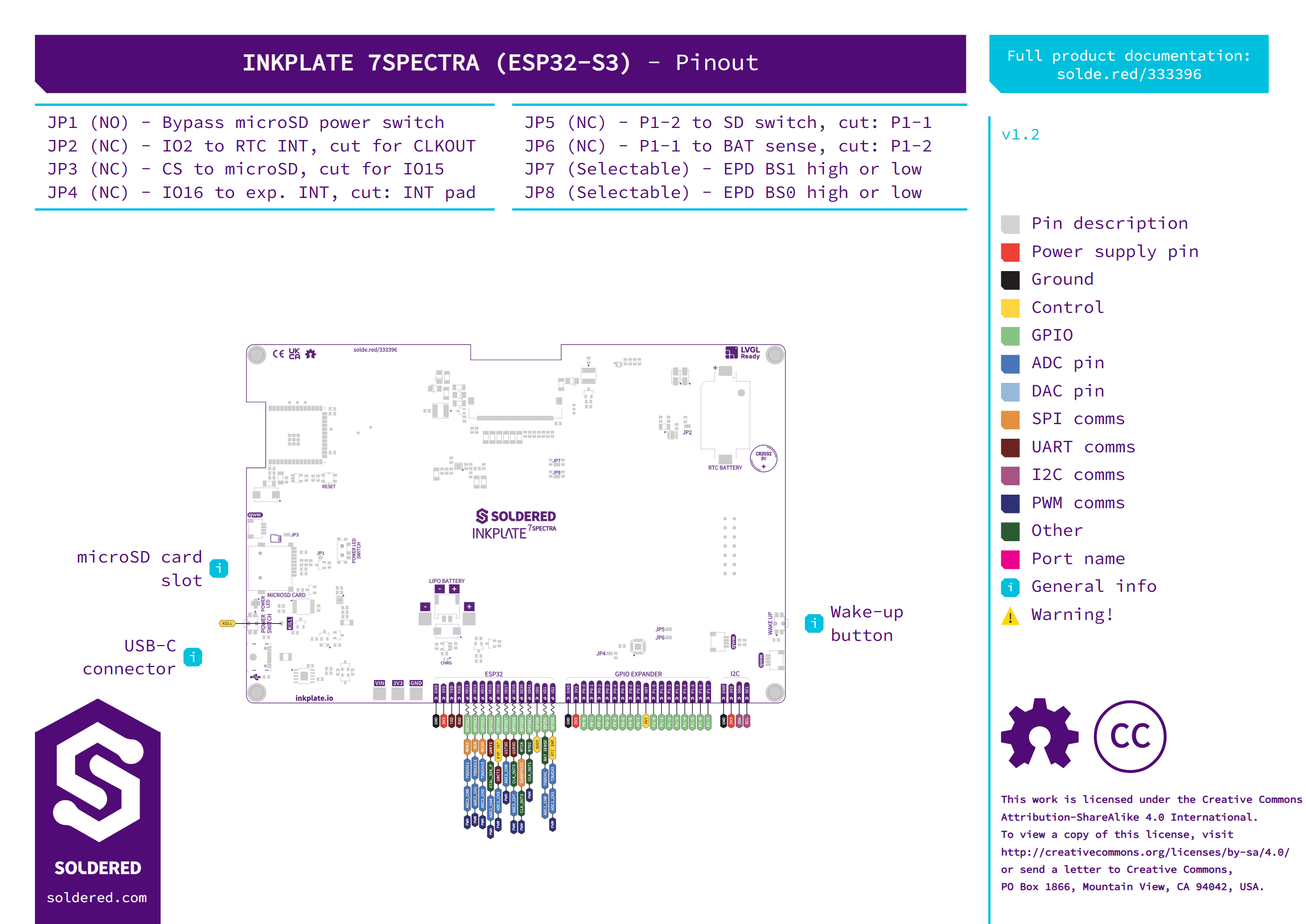
Available connections
| Board marking | Signal or expander pin | Capabilities and restrictions |
|---|---|---|
| ESP32: GND, 3V3 | Ground and 3.3 V | Power for what you connect. |
| ESP32: TXD, RXD | ESP32-S3 serial pins | Not used by either library's board file. |
| ESP32: IO11, IO12, IO13 | microSD card SPI (MOSI, CLK, MISO) | Used by the microSD card. |
| ESP32: IO15 | ESP32-S3 GPIO | Shared with the microSD card through JP3; see Jumpers. |
| ESP32: IO16 | GPIO expander interrupt | Connected to the expander's INT through JP4. |
| ESP32: IO17, IO39, IO41, IO0 | ESP32-S3 GPIO | Not used by either library's board file. |
| ESP32: IO18 | Wake-up button | Used to wake the board from deep sleep. |
| ESP32: IO1 | Battery voltage measurement | Read by readBattery() and read_battery(). |
| ESP32: IO2 | RTC interrupt | Connected to the RTC's INT through JP2. |
| GPIO EXPANDER: P0-0 to P0-7 | Expander pins 0 to 7 (IO_PIN_A0 to IO_PIN_A7) | Free for your use. |
| GPIO EXPANDER: P1-0 to P1-7 | Expander pins 8 to 15 (IO_PIN_B0 to IO_PIN_B7) | P1-1 switches the battery measurement and P1-2 the microSD supply; the rest are free. |
| GPIO EXPANDER: INT | Expander interrupt | See JP4. |
| I2C: GND, 3V3, SDA, SCL | I2C bus | Shared with the on-board expander (0x20) and RTC (0x51). |
| VIN, 3V3, GND | Power pads |
In MicroPython, begin() sets all 16 expander pins to outputs driven low. Set a pin's mode with gpio_expander_pin() after begin() when you need it as an input.