Soldered Ultra-Low-Power Accelerometer BMA400 Breakout
This breakout carries the Bosch BMA400, a 12-bit 3-axis accelerometer made for battery-powered devices. Besides raw acceleration, the chip counts steps, detects taps, orientation and activity changes, and buffers samples in a 1 KB FIFO, so your microcontroller can sleep until an interrupt wakes it. It talks over I2C (a two-wire bus for talking to chips) and has two Qwiic connectors, so you can plug it in without soldering.
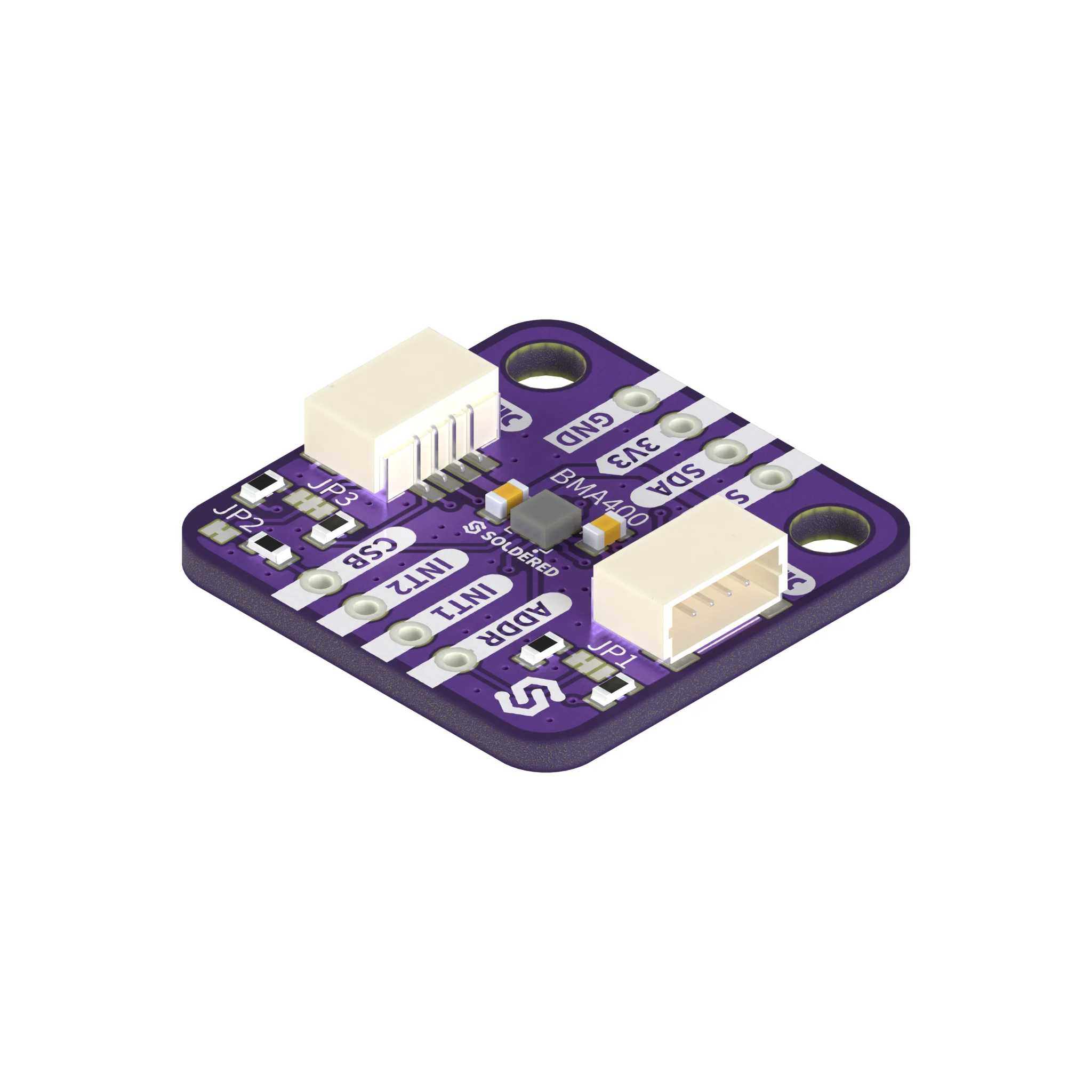
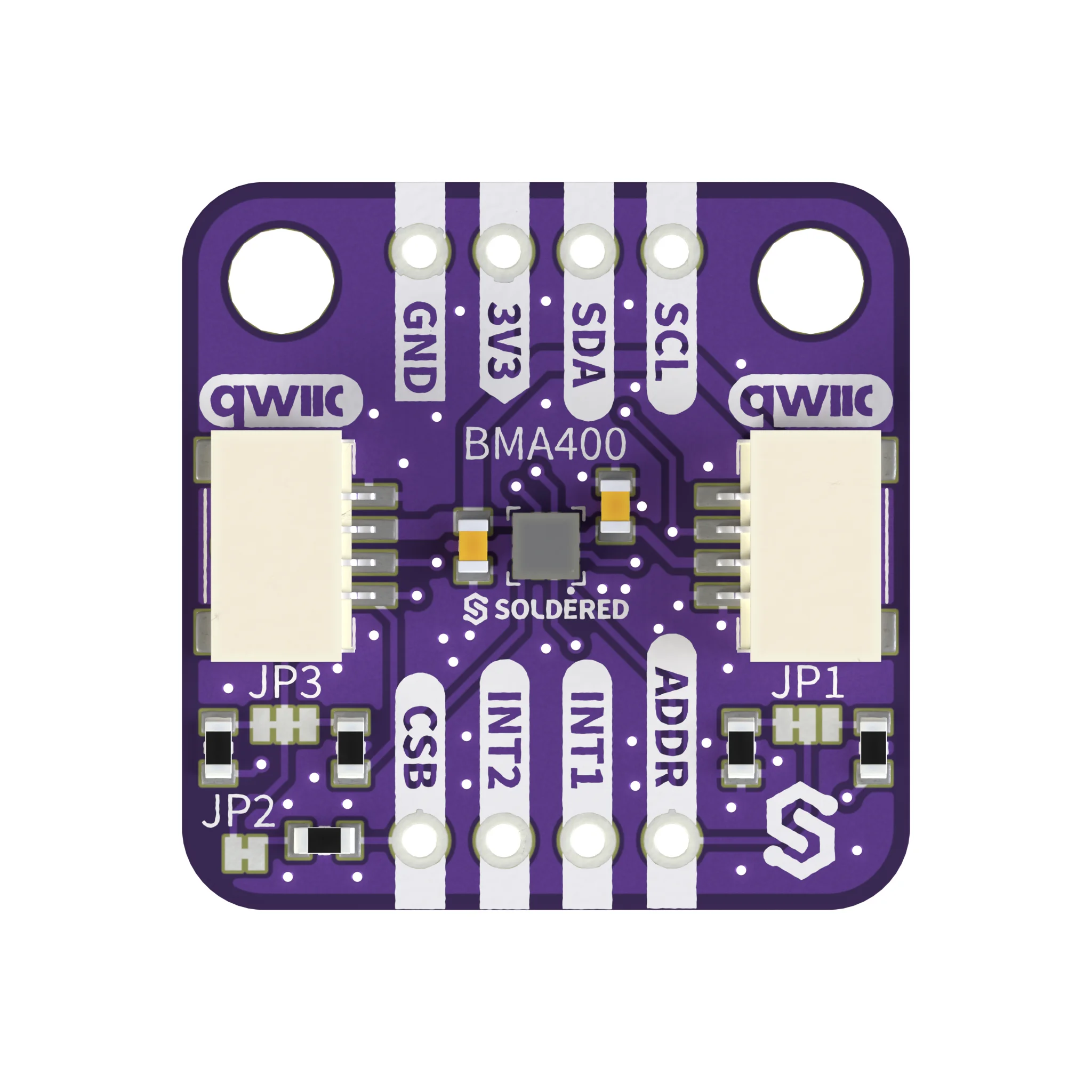
You pick a measurement range of ±2 g, ±4 g, ±8 g or ±16 g. In normal mode the output data rate goes from 12.5 Hz to 800 Hz. The BMA400 draws 14.5 µA in normal mode at its highest performance setting, 850 nA in low-power mode at 25 Hz with OSR=0 and 160 nA in sleep mode (datasheet typical values, nominal supply, 25 °C).
The board answers on I2C address 0x14, or 0x15 when you change the address
jumper or pull the ADDR pin high. Two 4-pin 2.54 mm headers bring out power,
I2C, ADDR, the two interrupt outputs INT1 and INT2, and CSB.
This documentation is for
At a glance
0x14 (default) or 0x15; INT1 and INT2 interrupt outputs3V3, no on-board regulatorWhat's in the box
| Qty | Item | Notes |
|---|---|---|
| 1 | Soldered Ultra-Low-Power Accelerometer BMA400 Breakout (main product) | 333419 |
| 1 | Header pins (unsoldered) | Header pins included for all breadboard-compatible pins |